Safety & Risks
A Grease Fire Inside the Oven: What to Do and What Not to Open
Leave the door shut. That is the whole of it, and it is the opposite of what people do. An oven cavity is already a sealed steel box, so a fire inside it runs out of oxygen and goes out on its own — opening the door feeds it air and pushes flame out into the kitchen at face height. So: leave the door closed, turn the oven off, and if you can do it safely, switch the circuit off at the breaker too. Do not throw water at it, do not open the door to look, and do not try to remove the tray. Watch it through the glass. Most oven grease fires are out within a minute or two. If it is still burning after that, if the flame is coming out around the door, or if there is smoke you cannot account for, leave the house and call the fire service. Afterwards, let the oven cool completely before opening it, and have the appliance looked at before using it again: an oven that has had a fire in it may have damaged wiring, a distorted seal or a heat-affected sensor even when it looks fine.
The full guide
What to do if grease fire in oven: leave the door shut
That is the answer, and it is the opposite of what almost everybody does.
Why shut
An oven cavity is a sealed steel box with a finite amount of air in it. A fire inside it consumes that air and goes out.
Opening the door does two things at once, both bad: it gives the fire a fresh supply of oxygen, and it releases whatever is burning outward, at face height, toward the person who opened it.
Most oven fires are out within a minute or two of being left alone. Almost every serious injury from one involves the door.
The sequence
- Door stays shut.
- Turn the oven off at the control.
- If you can reach it safely, switch the circuit off at the breaker.
- Watch through the glass. Give it a minute or two.
- If it is still burning strongly, or if flame is escaping around the door, get everybody out and call the fire service from outside.
Three things not to do
Do not throw water at it. Water on burning fat turns instantly to steam and throws burning fat with it. This is true in an oven and it is true on a cooktop.
Do not open it to look. The glass is there for exactly this.
Do not try to get the tray out. Whatever is in the oven is already lost. Nothing in there is worth reaching into a fire for.
Why the cooktop advice does not apply here
On an open cooktop, a pan fire is smothered — a metal lid, a baking sheet, a fire blanket — and baking soda works on a small one. All of that is about cutting off the air.
In an oven, the air has already been cut off. The cavity is doing the job. You are not adding a lid; you are the person who might remove one.
Afterwards
Let it cool completely. Hours, not minutes — a cavity that has had a fire in it holds heat, and on many machines the door will stay locked until it has cooled anyway.
Then clean it out properly, and have the appliance checked before using it again. That is not an upsell. Heat that intense can:
- damage wiring behind the cavity, which is where a later burning-plastic smell comes from;
- distort the door seal, so the oven never quite holds temperature again;
- affect the temperature sensor, so it reads wrongly from then on;
- trip a thermal cut-out that then trips early forever afterwards.
None of that is necessarily visible when you look inside.
Preventing the next one
Spillage on the cavity floor is the fuel. Everything else is detail.
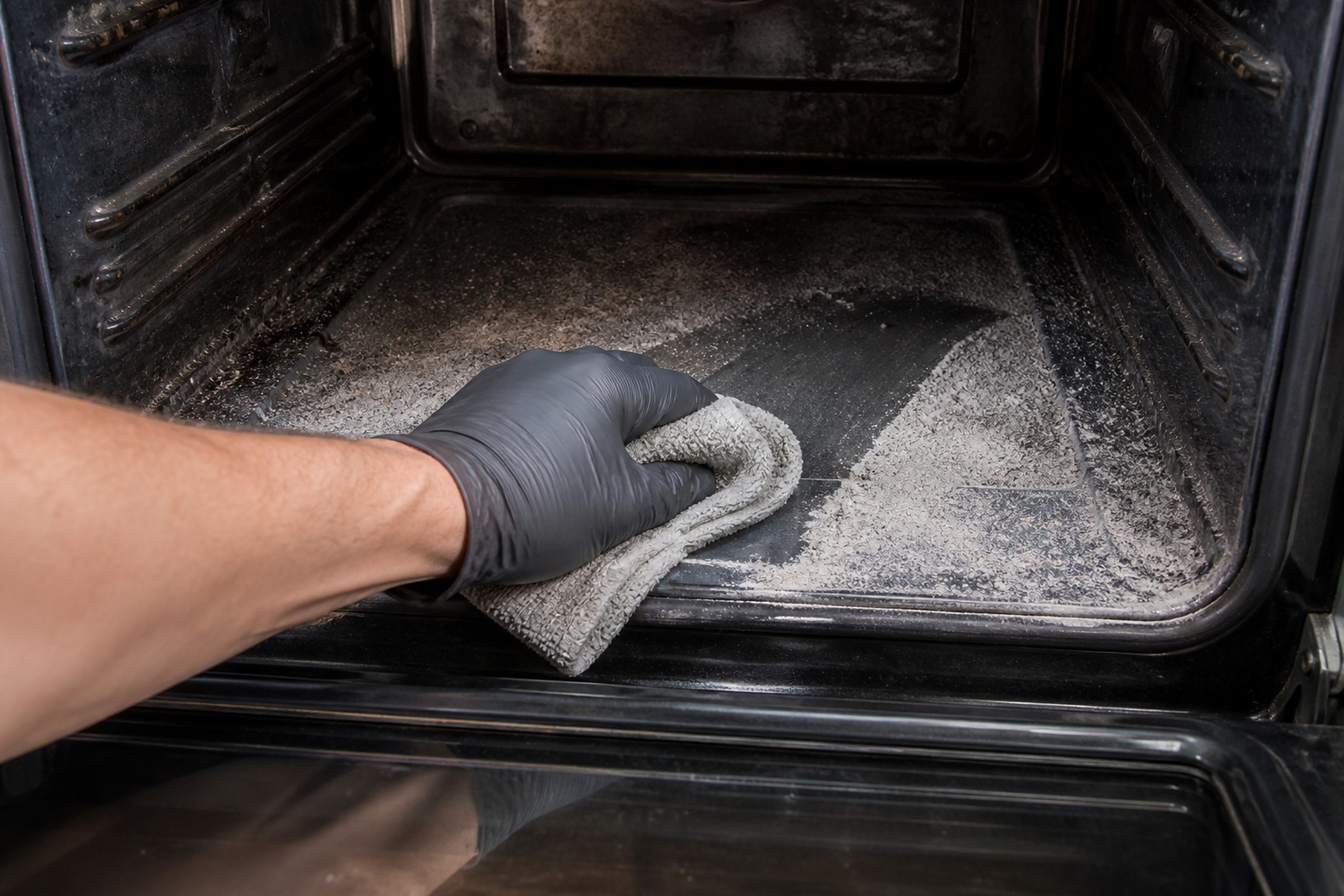
Clean it out — a self-clean cycle, or by hand with something that will not attack the coating.
Use a tray under anything that might overflow, particularly on a rack above another dish.
Do not line the oven floor with foil. It traps grease, it changes how heat moves through the cavity, and on several ovens it blocks the airflow the burner or element depends on. It is a common piece of advice and it is a bad one.
If it turns out to be a repair
What this leads to, and what it costs
Every job on this site is priced the same way: an on-site diagnostic first, the figure agreed in writing before anybody starts.
-
from $165 Oven door & self-clean lock repair
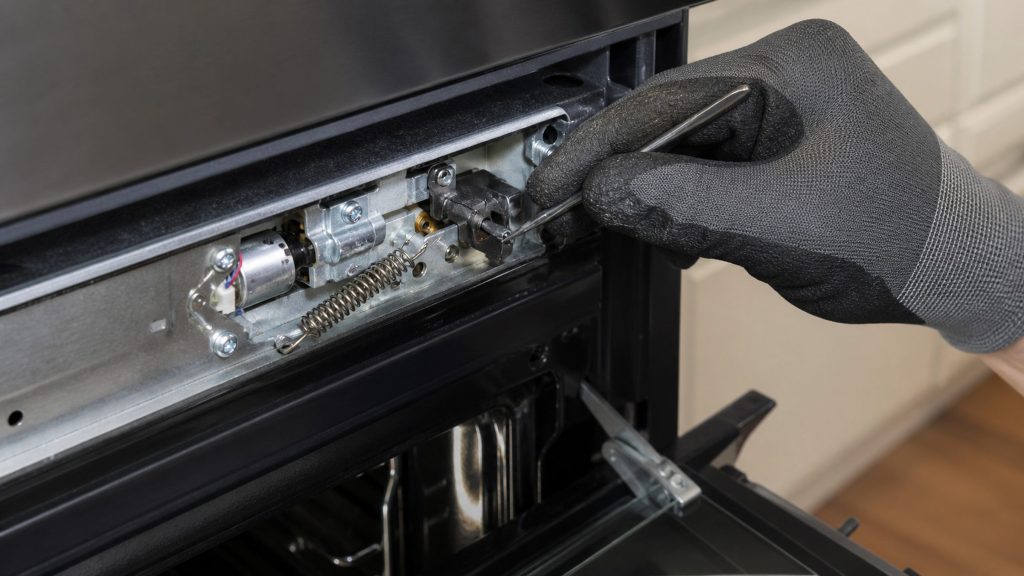
A door that will not close square, hinges that have given up under a heavy door, or a lock that engaged for a clean cycle and never let go. Eight of these ovens self-clean, and the post-clean lock is the single most common reason people call about an oven door.
- Give a locked door time to cool before anything is forced
- Hinges and springs replaced in pairs, because they wear together
- The seal checked at the same time — it is the reason the door matters
-
from $95 Diagnostic visit
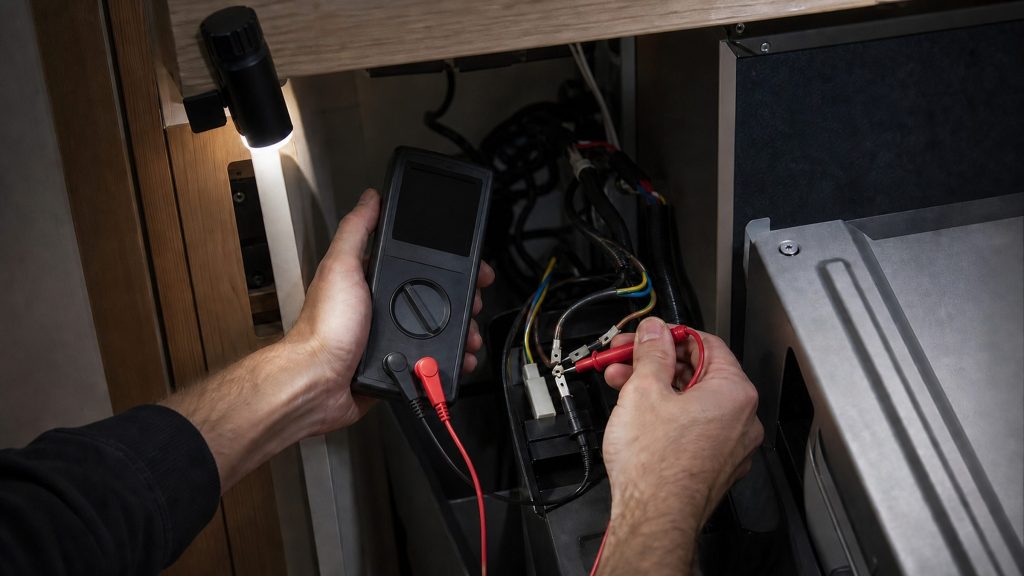
We work out what is actually wrong before anybody quotes a part. On this make that usually means measuring rather than reading, because most of these appliances report nothing at all when they stop. The fee is credited toward the work when you go ahead.
- Measured rather than guessed — resistance, current, temperature, airflow
- The free causes checked first, before any part is named
- Credited toward the repair
-
Single · Double · Speed oven · Steam · Self-clean · 24" · 30" Wall ovens
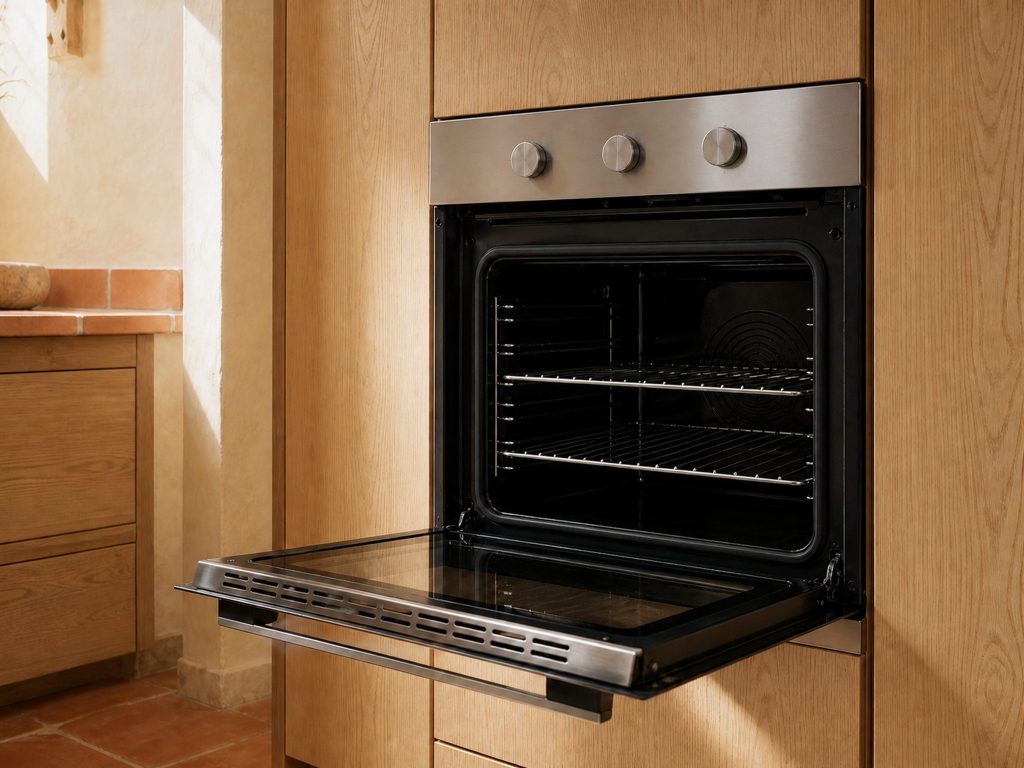
Eighteen built-in ovens, and they are not all the same machine. Five are speed ovens — a microwave and a convection oven sharing one cavity — five cook with steam, eight self-clean, and three carry the maker's own guided cooking. Two are doubles. What they have in common is that they are built into cabinetry, which decides how a repair starts: the oven comes forward before anything else happens.
- An oven that will not reach temperature, or overshoots it
- A door that locks after a clean cycle and stays locked
- A speed oven that heats on convection but no longer on microwave
Questions people ask about this
Why is the advice different from a cooktop fire?
Because a cooktop fire is in the open and an oven fire is already in a box. On a cooktop you are trying to cut off the air with a lid or a metal tray; in an oven that has already happened, and the only thing that can undo it is you opening the door.
Can I throw baking soda in?
Not without opening the door, which is the one thing to avoid. Baking soda is the right answer for a small pan fire on an open cooktop, not for a closed cavity that is already smothering itself.
The flame is coming out around the door.
Then it is beyond leaving alone. Get everybody out of the house and call the fire service from outside. A fire that has found enough air to escape a closed cavity is not going to run out of it.
How long should I watch before deciding?
A minute or two. Most oven fires are out in that time because the oxygen in the cavity is finite. If it is still going strongly after that, treat it as the serious case.
It went out. Can I use the oven tonight?
Let it cool completely first, then clean it out. Before using it again, have it checked: heat that intense can damage wiring behind the cavity, distort a door seal or affect a temperature sensor without leaving anything visible.
How do I stop it happening again?
Spillage on the cavity floor is the fuel, and a self-clean cycle or a hand clean deals with it. It is also worth using a tray under anything likely to overflow, and not lining the oven floor with foil — which traps grease and changes how heat moves in the cavity.
Safety & Risks
More guides like this one
-
Oven Smells Like Burning Plastic: Which Smell Means Stop
Five different smells, five different causes, and only two of them mean switch it off at the breaker. A page that treats them all the same is no use to anybody.
Read more -
What Happens When Refrigerant Leaks From a Refrigerator
Answers the safety question honestly, and then answers the one you actually needed: a sealed system does not consume refrigerant, so topping it up is not a repair.
Read more -
Mold on a Refrigerator Door Seal: Cleaning It Without Ruining the Seal
A humidity problem this city produces year-round, and the advice everywhere else uses bleach — which hardens the rubber and turns a cleaning job into a gasket.
Read more
Tell us the model number and what it is doing.
This article is based on:
- Official manufacturer documentation
- Internal repair procedures
- Technician repair history
- Company quality standards