Common Problems
Dishes Come Out Wet: What a Bertazzoni Dishwasher Is Actually Doing
Start with rinse aid and the Extra Dry option, because that is the maker's own answer and it resolves most of these. These machines dry by condensation rather than by blowing hot air: the final rinse is heated, the stainless tub is cooler than the load, and water evaporates off the dishes and condenses on the tub wall where it runs away. That process depends on two things — water leaving the dish surface as a sheet rather than as beads, which is exactly what rinse aid does, and the load being hotter than the tub. It also explains the complaint people find hardest to accept: plastic holds almost no heat, so it comes out of a perfectly working machine damp while the china beside it is bone dry. Real problems exist. A heating element or its sensor that has failed will show as F8 or F6 on the display, and a machine that is not draining properly leaves water to be re-evaporated. But if there is no code and the china is dry, the machine is working and the answer is rinse aid, dosing and how it is loaded.
The full guide
Why is my dishwasher not drying my dishes? Because of how it dries
There is no fan blowing hot air through the tub. There has not been on machines like this for a long time.
These dishwashers dry by condensation. The final rinse is heated, so the load comes out of it hot. The stainless tub is cooler than the load. Water evaporates off the dishes, meets the cooler tub wall, condenses there and runs away down the drain.
It is quiet, it uses very little energy, and it depends completely on two conditions being met.
Condition one: water has to leave as a sheet
This is what rinse aid does, and it is why the maker names it first when asked about wet dishes.
Without rinse aid, water sits on a plate as beads. A bead has a small surface area for its volume, so it evaporates slowly, and whatever is left behind dries as a spot. With rinse aid, the surface tension drops and the same water spreads into a sheet — far more surface area, far faster evaporation, and no spots.
On South Florida water this matters more than it does in most places. Hard water fights you on both counts.
All-in-one tablets do include some rinse aid, at a fixed dose. On hard water that dose is frequently not enough. Fill the separate reservoir anyway.
Condition two: the load has to be hotter than the tub
Which brings us to the complaint people find hardest to believe.
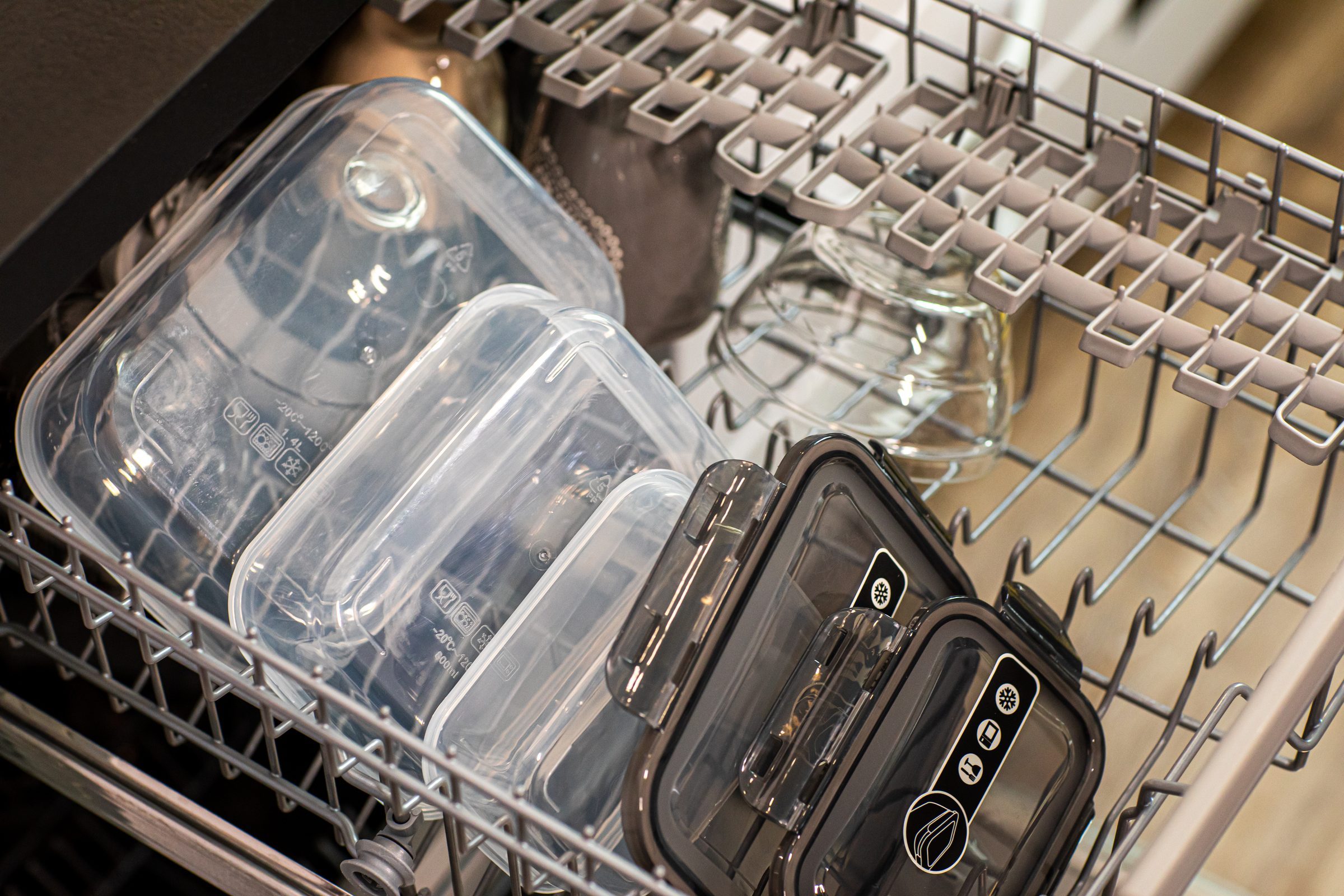
Plastic comes out damp on a machine that is working perfectly. It is not a problem and no repair will change it. Plastic has almost no thermal mass, so it drops to tub temperature within seconds of the rinse ending and stops evaporating anything. China and glass hold heat and go on drying themselves for twenty minutes.
If your china is dry and your storage boxes are wet, your dishwasher is fine.
The three free things to try
Use the Extra Dry option. The maker recommends it alongside rinse aid, and it lengthens and heats the final rinse.
Crack the door open at the end. Ten minutes is enough to let the last of the moisture out as steam. It also prevents the smell that develops in a closed damp tub — the maker separately recommends leaving the door ajar when the machine is not in use for exactly that reason.
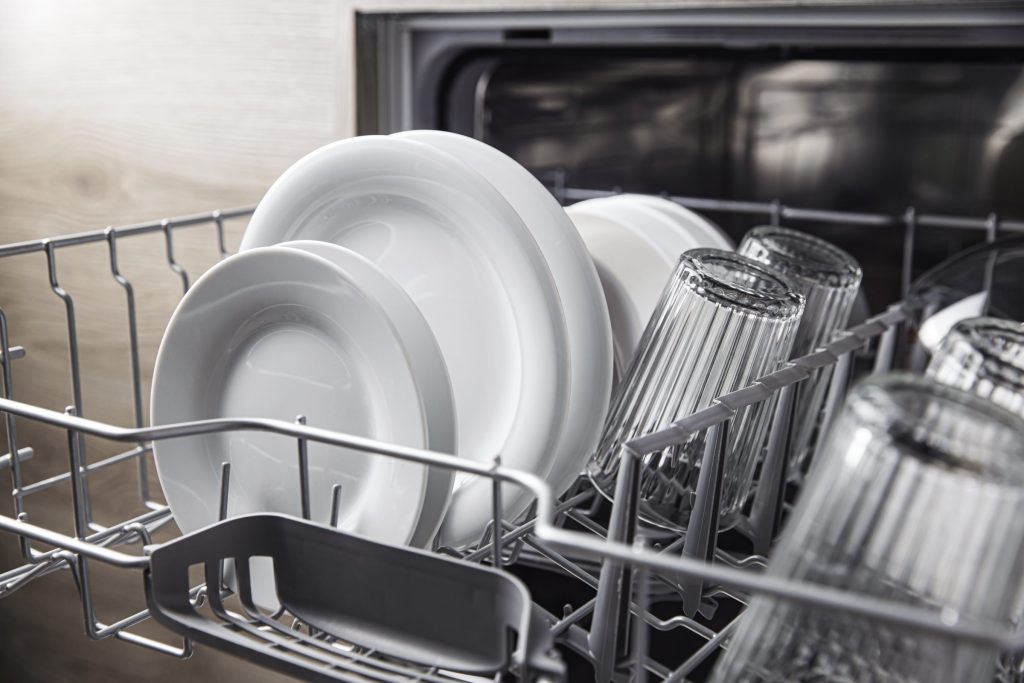
Load so water can escape. Cups and bowls angled rather than flat, nothing nested, tall items where they do not shield everything behind them. Water pooled in an upturned base was never going to evaporate.
When it is actually a problem
These are the machines in this line that publish codes, which makes this easier than it is on the rest of the kitchen.
F8 — heater error. The element or its circuit. Drying and washing both suffer.
F6 — failed heater sensor. The machine cannot read its own water temperature, so it either does not heat or does not stop.
F2 — will not discharge water. Water that stays in the tub gets re-evaporated onto everything above it. Wet dishes are a side effect; the drain is the cause.
Write the code down before clearing it. On these machines it is a genuine diagnosis rather than a hint.
What to have ready if you do call
Whether the china is dry and only plastic is wet — that answer alone may end the call. Whether there is a code. Whether the rinse aid reservoir is full and what the dosing is set to. And whether anything changed the week it started.
If it turns out to be a repair
What this leads to, and what it costs
Every job on this site is priced the same way: an on-site diagnostic first, the figure agreed in writing before anybody starts.
-
Often a bottle, not a part Dishwasher not drying
Everything comes out clean and wet, or plastics stay soaked while china is fine. Before anybody quotes a heater it is worth knowing that on a condensation-drying machine rinse aid is not optional — without it, water sheets and stays.
- Clean but wet at the end of every cycle
- Plastics wet while china is dry
- Drying that got worse gradually
-
from $155 Dishwasher wash & heat repair
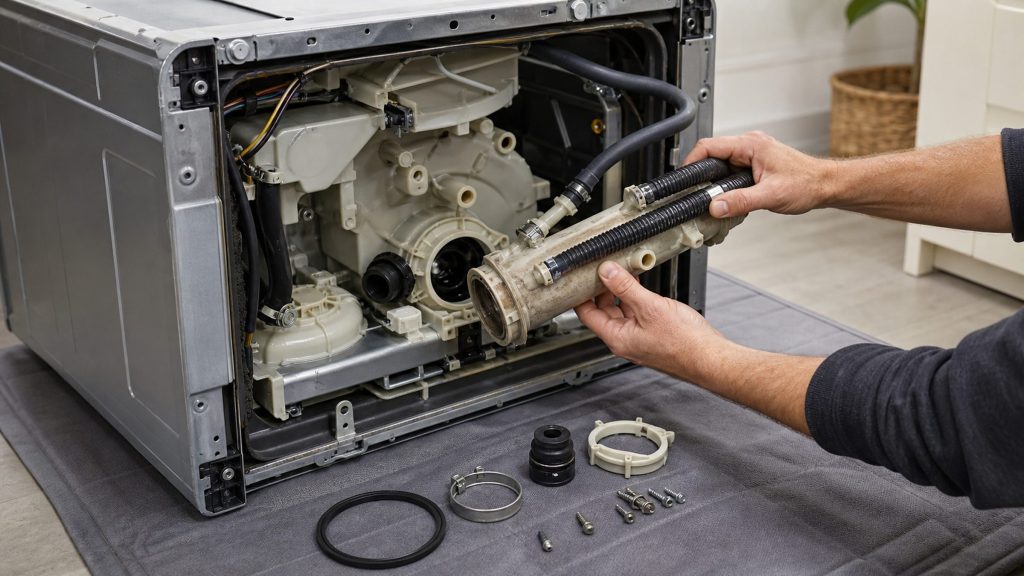
The cycle runs, the time counts down, and nothing comes out clean or dry. On this make, and in this city, hard water is behind more of these than any component — spray arms narrowed by scale, a heater working harder than it should, and a filter nobody has lifted in a year.
- Spray arms, scale and water temperature checked before any pump talk
- Wash and dry treated as two different complaints
- Descale where scale is the answer, rather than a part
-
from $215 Dishwasher control & electronics repair cost
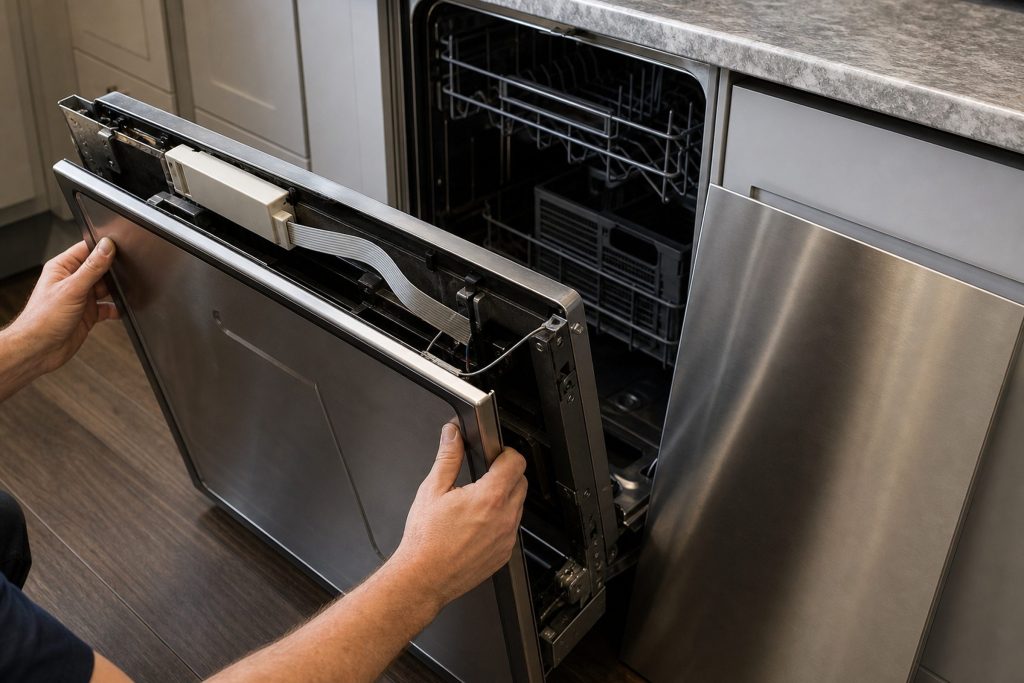
The highest dishwashing row, and the one where the machine's own error table earns its keep: F5, F7, F9 and HI all point here, and the difference between them is most of the diagnosis.
- Control board, wash pump, pressure system or wiring
- F5, F7, F9 and HI are the maker's codes for this half
- Write the code down before you clear it
Questions people ask about this
Do I really need rinse aid if my detergent says all-in-one?
For drying, yes. All-in-one tablets carry some rinse aid but at a fixed dose, and on hard South Florida water that dose is frequently not enough. Filling the separate reservoir costs a few dollars a year and it is the single most effective change you can make to drying performance.
Why do plastics come out wet when everything else is dry?
Because plastic has almost no thermal mass. Condensation drying relies on the load holding heat from the final rinse and giving it up slowly; china and glass do, plastic does not, so it cools to tub temperature almost immediately and stops evaporating. It is a property of the material, not a problem in the machine.
Should I open the door at the end?
It helps, and cracking it open for ten minutes after the cycle lets the remaining moisture out as steam. It also stops the smell that develops in a closed damp tub, which the maker specifically recommends leaving the door ajar to prevent.
The machine shows F8. Is that drying?
It is the heater, which affects drying and washing both. F8 is a heater error and F6 is a failed heater sensor, and both come from the maker's own error table rather than from anyone's guesswork. Either one is a service call — write the code down before you clear it.
It used to dry fine and now it does not.
Check the rinse aid reservoir first, then the dosing setting, then whether anything changed about the load or the detergent. If all three are unchanged, the next suspect is water temperature — a heater that is weakening rather than failed heats less water each cycle and drying is the first thing to suffer.
Would a hotter cycle help?
Usually yes, and it is free to try. A longer, hotter program puts more heat into the load, which is exactly what condensation drying needs. The trade is time and energy; on a machine that is genuinely healthy it is often the whole answer.
Common Problems
More guides like this one
-
Why a Bertazzoni Oven Keeps Shutting Off, and Which Half of It Is Wrong
An oven that never heats and an oven that heats and then stops are different problems with different parts. On a gas machine the second one is nearly always flame sensing; on the electric half it is a thermal cut-out or a relay.
Read more -
Oven Broils but Will Not Bake: What That Split Tells a Technician
A split problem names the part before anybody arrives. Broil works and bake does not, or the reverse, and either way half the appliance has just been eliminated from the diagnosis.
Read more -
Reading the Analog Temperature Gauge on a Bertazzoni Range
The maker says plainly that the gauge is a reference point rather than a measurement. Owners read the gauge, see a gap, and book a calibration call. Here is what the gap means and where a real problem starts.
Read more
Tell us the model number and what it is doing.
This article is based on:
- Official manufacturer documentation
- Internal repair procedures
- Technician repair history
- Company quality standards