Safety & Risks
Gas Smell From the Oven When You Turn It On — and When You Do Not
If everything is switched off and you can smell gas, leave. Do not touch a light switch, a phone or the oven, open a door on the way out if it is on your way, and call the gas utility from outside. That case is never normal and it is not an appliance appointment. The other case is different: a brief smell for a few seconds as a gas oven lights is the gas that flowed before the burner caught, and on an oven with a slow-igniting burner there can be a noticeable amount of it. That is worth attention but not evacuation, because it means ignition is taking too long — usually a tired ignitor, a fouled electrode, or a burner port pattern that has changed. The middle case is the one people miss: a faint smell only when the oven is running that never quite goes away. That is incomplete combustion rather than a leak, it produces its own risks, and it needs a proper burner and combustion check rather than a sniff test.
The full guide
Gas smell from oven when turned on: three cases, and only one is an emergency
Case one: everything is off and you can smell gas
Leave.
Do not operate a switch — not a light, not the extractor, not the oven. Do not use a phone indoors. If a door or a window is on your way out, open it; do not go around the house opening things.
Call the gas utility from outside. They treat this as an emergency and they come out for it.
This is not an appliance repair call. It becomes one afterwards, if the utility finds the source is the appliance rather than the supply.
Case two: a brief smell as the oven lights
This one is ordinary, and it is still telling you something.
When a gas oven lights, gas flows for a moment before the burner catches. On a healthy appliance that moment is short and you barely notice it. On an oven whose ignition has slowed, more gas accumulates before it lights, and you get a distinct few seconds of smell followed by a slightly emphatic ignition.
That is not a leak. It is the same drift that shows up as a preheat time creeping from twelve minutes to twenty, and it has the same cause: an ignitor aging, an electrode fouled, a burner port pattern that has changed.
Book it as a routine job. It gets worse rather than better, and the part is inexpensive.
Case three: a faint smell the whole time it runs
The one people ignore longest, because it is not dramatic.
A smell that persists while the oven is running is more likely to be combustion than a leak — a burner running rich, a blocked port pattern, an air supply that has changed because a hood was upgraded or a window is now always shut. What that produces is not just an odor; it is products of combustion in a kitchen.
It needs the burner, the flame and the air supply looked at properly. It is not something to diagnose by nose over several weeks.
What a normal flame looks like
Worth knowing, because on this equipment the flame is the diagnosis.
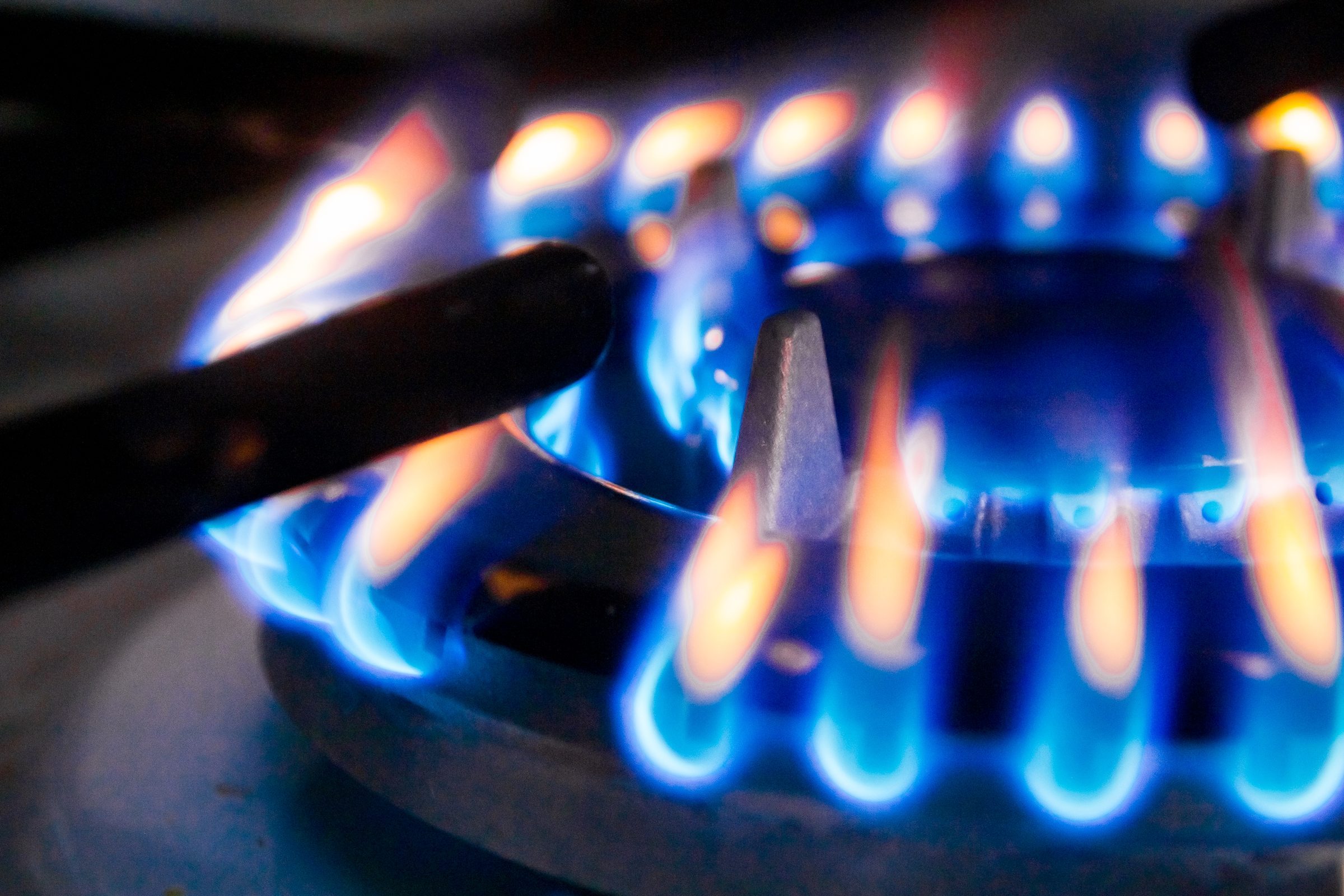
Blue, stable, sitting on the port. Small yellow tips at the very top are acceptable and common on natural gas.
Lifting off the port — a flame that hovers with a gap beneath it — means too much gas or too little air.
Largely yellow and lazy, with soot appearing on pans, means the opposite: not enough air, incomplete combustion, and that is the case-three smell.
Uneven around the ring usually means a blocked port or a cap that is not seated flat, which is the commonest and cheapest of all of these.
Two things never to do
Never look for a gas leak with a flame. It reads as obvious written down and it still happens.
Never clear burner ports with wire or a drill bit. It permanently changes the flame, and a burner opened out that way is a replacement rather than a service.
What to have ready if you book
Whether the smell happens with everything off, only at ignition, or throughout. What the flame looks like — blue, yellow, lifting, uneven. Whether anything was moved or serviced recently. And the model number, which on a range is behind the kick panel at the floor.
If it turns out to be a repair
What this leads to, and what it costs
Every job on this site is priced the same way: an on-site diagnostic first, the figure agreed in writing before anybody starts.
-
Spark, gas, or seating Burner will not light
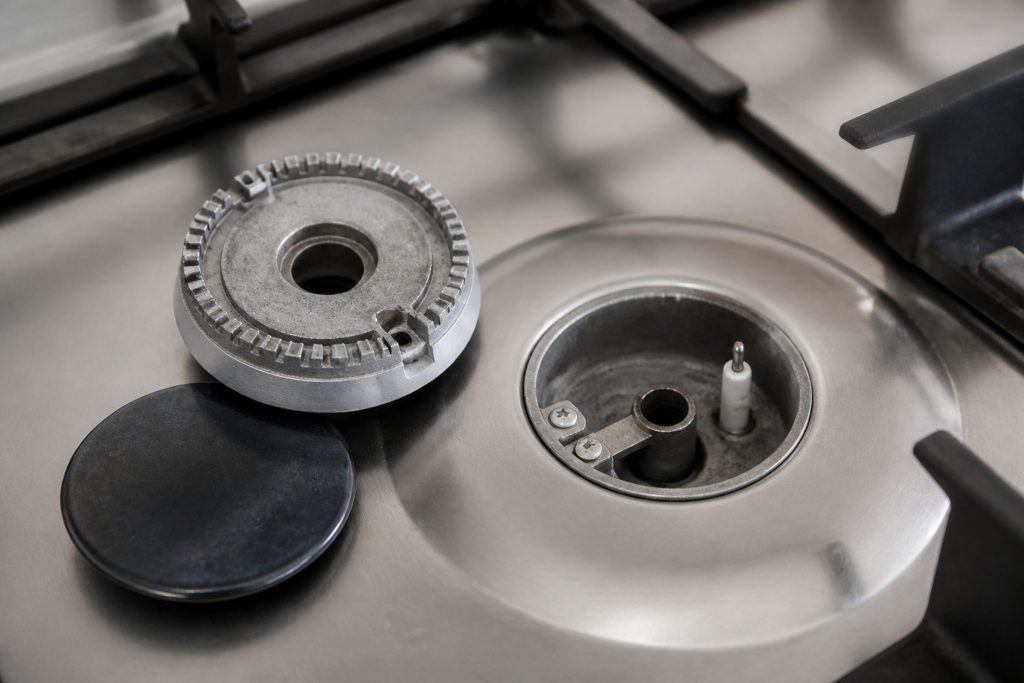
It clicks and nothing catches, or one burner lights and the others do not, or there is no click at all. Nineteen of the thirty-four surfaces in this line are gas, and two of the four things that cause this cost nothing to put right.
- Clicking with no flame
- One burner out while the rest are fine
- No click and no spark at all
-
from $195 Gas oven ignition & safety valve repair
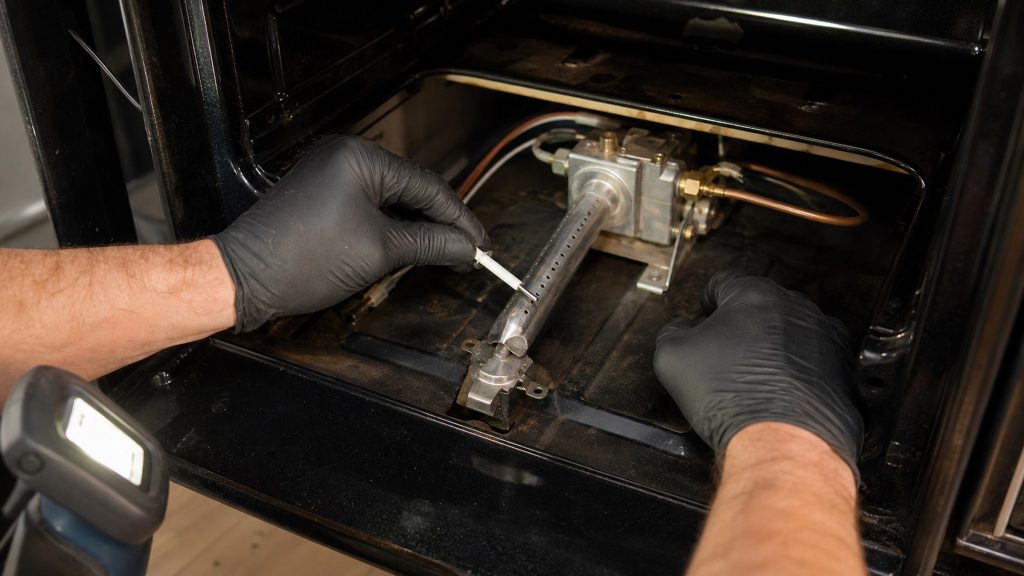
Eleven of these ranges are all gas, which means the oven is a burner too. A gas oven that will not heat is almost never the control and almost always the igniter and the safety valve working as a pair — and it is a repair that has to be done in the right order to be done safely.
- Igniter current measured under load, not judged by whether it glows
- The safety valve treated as half of the same circuit
- A full cycle watched from cold before we leave
-
from $95 Diagnostic visit
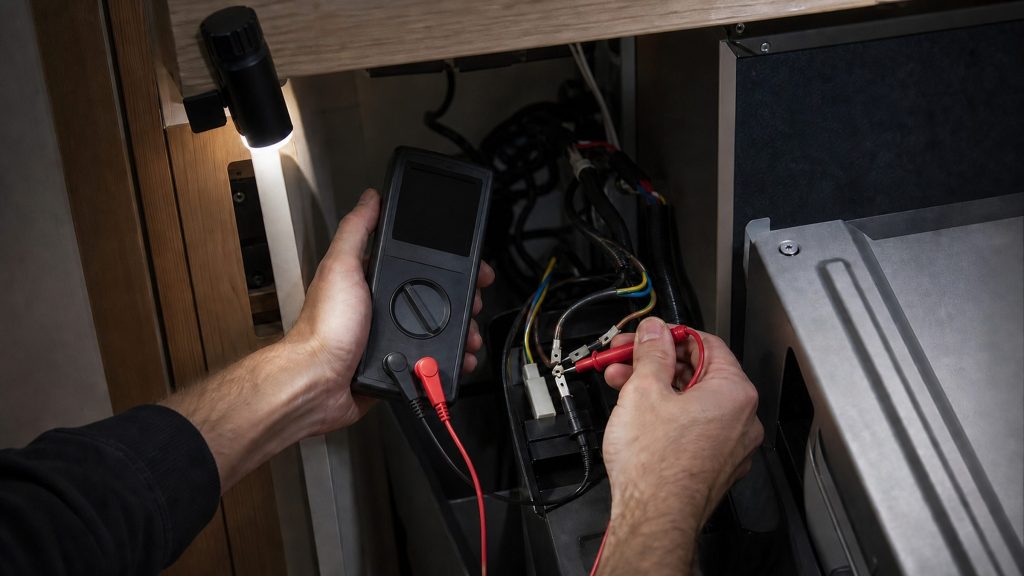
We work out what is actually wrong before anybody quotes a part. On this make that usually means measuring rather than reading, because most of these appliances report nothing at all when they stop. The fee is credited toward the work when you go ahead.
- Measured rather than guessed — resistance, current, temperature, airflow
- The free causes checked first, before any part is named
- Credited toward the repair
Questions people ask about this
I can smell gas and the oven is off. What do I do right now?
Leave the building. Do not operate any switch, including a light or an extractor, and do not use a phone indoors. If a door or window is on your way out, open it. Call the gas utility from outside — they treat this as an emergency and they come. This is not an appliance repair call until they have been.
It smells for a few seconds when the oven lights and then stops.
That is unburnt gas from before the burner caught, and a few seconds of it is ordinary. What it is telling you is that ignition is slow, and slow ignition gets slower. Worth booking as a routine job rather than an emergency — the fix is usually an ignitor or a cleaned electrode.
There is a smell whenever it runs, faint but constant.
That is more likely to be combustion than a leak. A burner running rich, a blocked port pattern, or a poor air supply produces a smell and, more importantly, produces products of combustion you do not want in a kitchen. It needs the burner and the flame checked properly rather than a sniff test.
Can I check for a leak with soapy water?
On an accessible connection, that is what a technician does — and never with a flame, ever. But the connections on a built-in appliance are mostly not accessible without moving it, and moving a gas appliance is how a small problem becomes a large one. If you already suspect a leak, the utility comes first.
The smell started after the range was moved or serviced.
Say so immediately, and treat it as the serious case. Any connection that has been opened is the first suspect, and a flexible connector that has been kinked or over-bent during a move can leak without anything looking wrong.
Is the smell of a brand-new range normal?
A new appliance produces smells for the first few uses — manufacturing oils burning off — and those are sharp and hot rather than the distinct sulfur smell added to natural gas. If what you can smell is the gas odorant itself rather than burning oil, treat it as the serious case regardless of how new it is.
Safety & Risks
More guides like this one
-
Oven Smells Like Burning Plastic: Which Smell Means Stop
Five different smells, five different causes, and only two of them mean switch it off at the breaker. A page that treats them all the same is no use to anybody.
Read more -
What Happens When Refrigerant Leaks From a Refrigerator
Answers the safety question honestly, and then answers the one you actually needed: a sealed system does not consume refrigerant, so topping it up is not a repair.
Read more -
A Grease Fire Inside the Oven: What to Do and What Not to Open
Specifically the oven rather than the cooktop, because the correct action is the opposite one. The cavity is already a sealed box. Short page, because somebody reading it has minutes.
Read more
Tell us the model number and what it is doing.
This article is based on:
- Official manufacturer documentation
- Internal repair procedures
- Technician repair history
- Company quality standards