Common Problems
Reading the Analog Temperature Gauge on a Bertazzoni Range
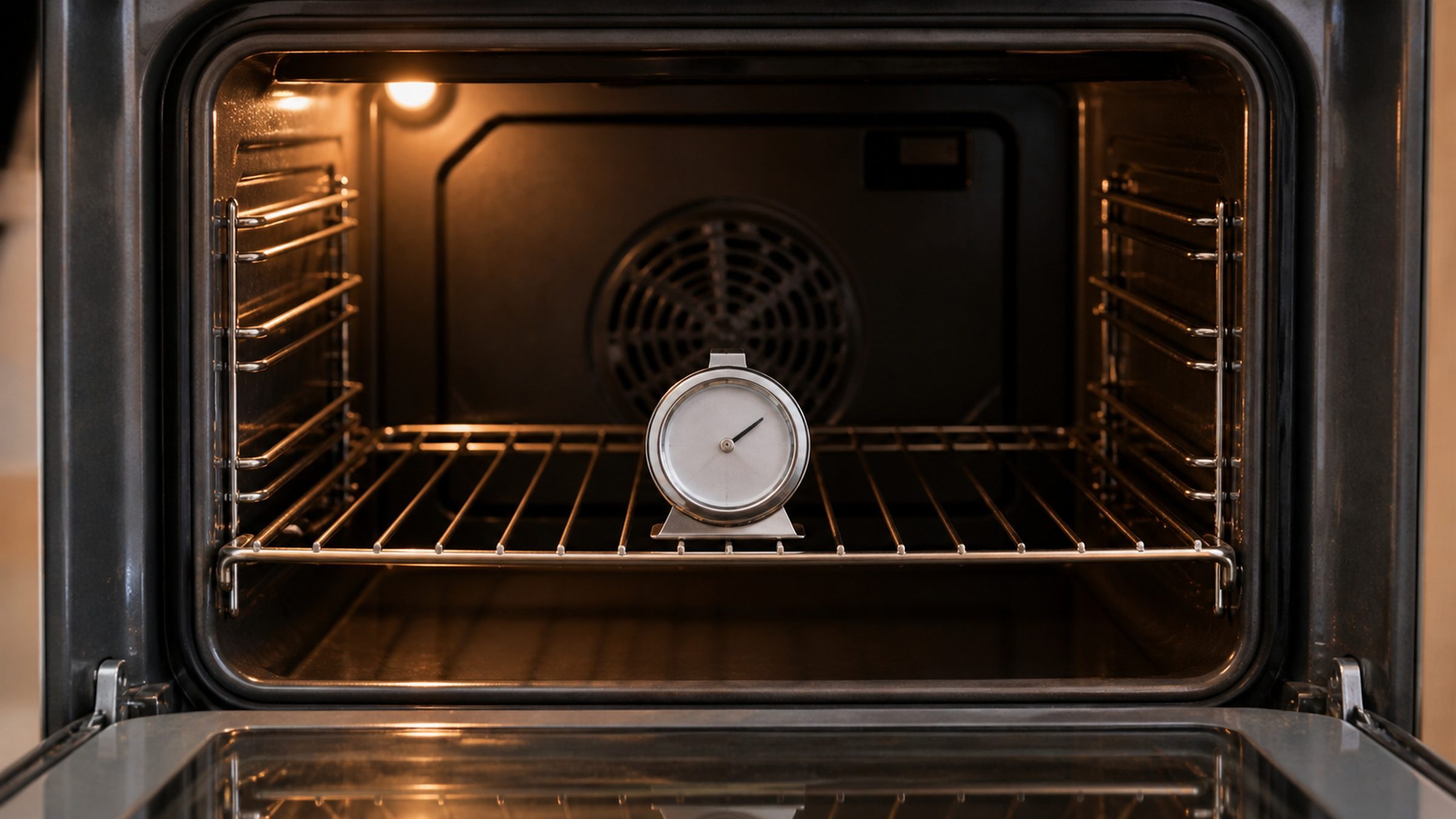
Read it as an arrival indicator rather than as a thermometer. The maker's own guidance is that the gauge is best used to understand when the oven has reached the temperature set on the thermostat and when it has cooled down again, and that you should cook to the setting on the knob rather than to the needle. The reason it disagrees is that the needle sits in the door, reading air near the glass, while the thermostat senses the cavity — and a working oven cycles its burner on and off around the set point, so the true temperature is a band rather than a number and the gauge is watching it swing. A gap of twenty or twenty-five degrees between the needle and the knob is ordinary. A gap of fifty or more, measured with an independent oven thermometer hung in the middle of the cavity rather than read off the door, is a calibration or sensor problem worth looking at. These ovens have an offset adjustment for exactly that reason.
The full guide
Bertazzoni oven temperature gauge how to read it, and what it is not
It is an arrival indicator. That is the maker's own position, and it is worth taking seriously before spending money.
The guidance is direct: use the gauge to understand when the oven has reached the temperature set on the thermostat, and when it has cooled down again. Cook to the setting on the knob. The needle is there to tell you the oven has settled, not to tell you what the cavity is doing to the nearest degree.
Why the needle and the knob disagree
Three reasons, all of them ordinary.
The needle is in the door. It reads the air nearest the glass, which is the coolest air in the cavity. The thermostat senses somewhere warmer. A twenty-degree gap between the two is not an error; it is two instruments in two places.
The oven cycles. An oven holds temperature by heating past the set point and coasting back down. The true temperature is a band, perhaps thirty degrees wide, and the needle is watching it swing. A gauge that sat perfectly still would be the odd one.
The door is a thermal weakness. Glass, hinges and a seal, with room air on the other side. The part of the cavity nearest the door is genuinely cooler, and that is where the gauge lives.
The test that is worth doing
If you actually want to know what your oven does:
- Hang an independent oven thermometer from a rack in the middle of the cavity. Not on the floor, not against a wall.
- Preheat to 350°F and then wait a further fifteen minutes. The walls need to catch up.
- Read it three or four times over ten minutes.
- Take the middle of the swing, not the highest or lowest number you saw.
That figure is worth acting on. A reading taken from the door gauge, or from a thermometer that spent the test lying on the oven floor, is not.
Where a real problem starts
Twenty to twenty-five degrees between the needle and the knob: ordinary.
Thirty to forty degrees on an independent thermometer, consistently: this is what the oven's offset adjustment exists for, and it is a setting rather than a repair.
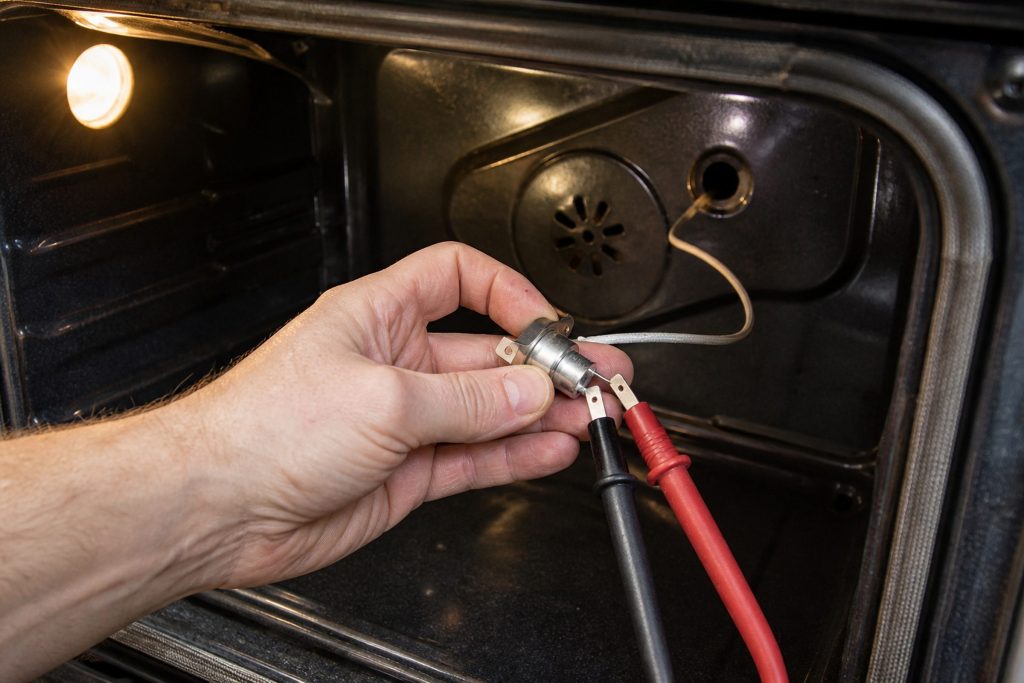
Fifty degrees or more, in either direction: worth a visit. On this equipment there is no code to read, so the diagnosis is a measurement — a temperature sensor is a known resistance at a known temperature, and a drifted one is identified in minutes rather than argued about.
One trap: do not use the offset to make the door gauge agree with the knob. The gauge is not measuring what the knob sets. Adjusting the oven to satisfy it leaves the cavity genuinely wrong, and every recipe you cook afterwards pays for it.
Running hot is worth more attention than running cold
Most people notice a cold oven because things take longer, and adapt without thinking about it.
An oven running forty degrees hot burns pastry and dries a roast at the settings a recipe assumes, and people conclude they are bad cooks. If yours has started catching things at the edges, check it properly before changing anything else.
If it turns out to be a repair
What this leads to, and what it costs
Every job on this site is priced the same way: an on-site diagnostic first, the figure agreed in writing before anybody starts.
-
Obedient, and aiming at the wrong number Oven running hot, cold or uneven
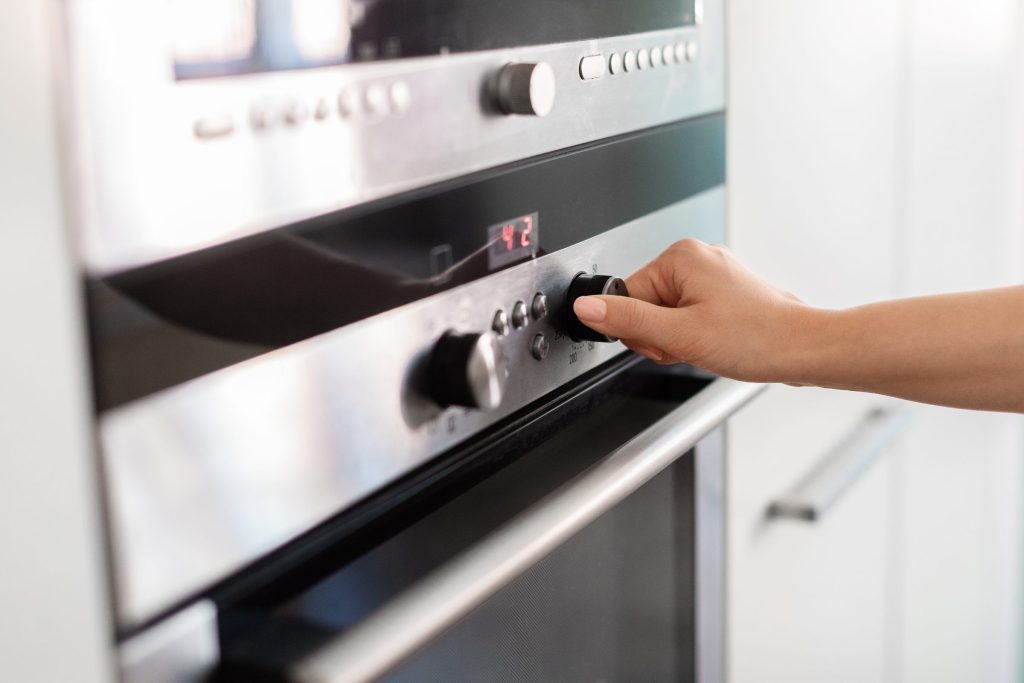
An oven that heats perfectly to a temperature that is not the one you set, or that browns on one side and undercooks on the other. Almost always a measurement problem rather than a heating one — and on this make it is measured with a thermometer, because there is nothing to read.
- Everything browning too fast or too slowly
- One side or one shelf consistently darker
- Baking that changed without anything else changing
-
from $185 Oven heating & sensor repair
An oven that will not reach temperature, overshoots it, or takes twice as long as it used to. Three parts account for almost all of it, and the one that fails most often is also the cheapest — which is why nothing here is ordered before the sensor has been measured.
- The sensor measured cold, in a minute, before anything is opened
- Bake, broil and convection tested as three separate circuits
- The door seal checked, because an oven cannot hold what it leaks
Questions people ask about this
My gauge never reaches the number on the knob.
That is common and usually correct behavior. The needle is in the door reading air near the glass, which is the coolest air in the cavity, and the thermostat is sensing somewhere warmer. Use the gauge to tell you the oven has settled, and trust the knob for the temperature.
How do I check the oven properly?
An independent oven thermometer, hung from a rack in the center of the cavity, not sitting on the floor and not touching a wall. Preheat, let it settle for a further fifteen minutes, then read it a few times over ten minutes and take the middle of the swing. That is the number worth acting on.
The needle moves up and down while I am cooking. Is that a problem?
No, it is the burner cycling. An oven holds temperature by heating past the set point and coasting back down, so the real temperature is a band. A needle that never moves at all would be more suspicious than one that swings.
Can the oven be calibrated?
There is an offset adjustment on these machines, and a genuine drift of thirty or forty degrees is what it exists for. It is not the answer to a gauge that disagrees with the knob — offsetting an oven to make a door gauge line up will leave the cavity genuinely wrong.
It reads high, not low.
Less common and more worth checking, because an oven running hot burns things at the settings a recipe assumes. Confirm with an independent thermometer before adjusting anything; a needle reading high on a door that no longer seals is measuring escaping heat rather than the cavity.
My built-in oven has a display instead. Same thing?
The principle is the same: the displayed number is what the sensor reports and there is still a cycling band behind it. The difference is that a digital sensor can be checked against a known resistance, so a drift is measurable rather than argued about.
Common Problems
More guides like this one
-
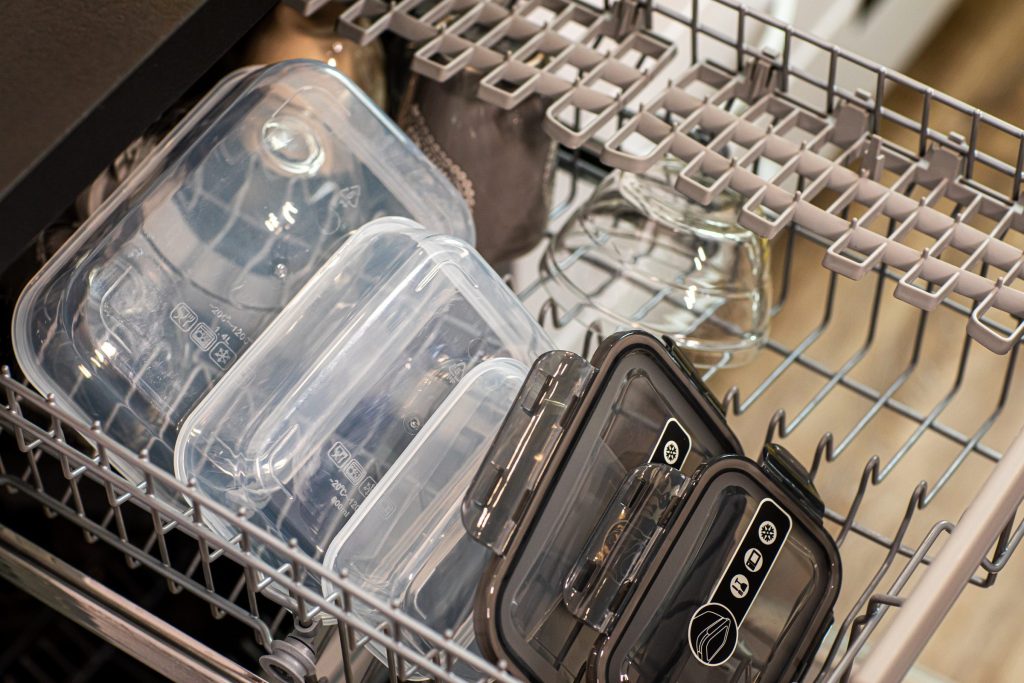
Dishes Come Out Wet: What a Bertazzoni Dishwasher Is Actually Doing
The maker's own answer is rinse aid plus the Extra Dry option, and it is right far more often than a heater problem is. Here is why plastics stay wet on a machine that is working perfectly.
Read more -
Why a Bertazzoni Oven Keeps Shutting Off, and Which Half of It Is Wrong
An oven that never heats and an oven that heats and then stops are different problems with different parts. On a gas machine the second one is nearly always flame sensing; on the electric half it is a thermal cut-out or a relay.
Read more -
Oven Broils but Will Not Bake: What That Split Tells a Technician
A split problem names the part before anybody arrives. Broil works and bake does not, or the reverse, and either way half the appliance has just been eliminated from the diagnosis.
Read more
Tell us the model number and what it is doing.
This article is based on:
- Official manufacturer documentation
- Internal repair procedures
- Technician repair history
- Company quality standards